
Ducati.com

THEORY AND HISTORY OF THE DUCATI DESMODROMIC ENGINE
In the world of motorcycling, it was generally believed that the Desmodromic system controlling valve motion was the result of the difficulties experienced in making return springs.
Today, given the technological evolution of materials, these difficulties no longer exist.
Many wonder if this system is still worth using – judging it complex, expensive and high-maintenance.

An in-depth, thorough study on gas motion and flow control devices, however, confirms the system efficiency and, in this

-
Fabio Taglioni
paper, I will briefly try and explain the many different reasons for this.

The 4-stroke internal combustion engine has evolved dramatically and continuously since its birth, thanks not only to the considerably improved quality of today’s materials, but also to the evolution of thermodynamics, enabling the improvement of cycle efficiency. This was possible because even the smallest of manufacturers today have access to increasingly sophisticated data measuring instruments, enabling them to investigate the various fluid and thermodynamic phenomena at the basis of engine development.

I am referring here to those fluid-dynamic effects influenced by the control system parts involved in the intake and exhaust strokes of 4-stroke engines, and in particular, valves operating by lifting off their seats, known as mushroom or poppet valves. As is known, the flow inside a duct or port can be controlled in different ways, more or less complex and efficient in terms of engine construction and functional characteristics.

Desmodromic Engine
-
After determining the valve stroke (or lift off the valve seat), opening and closing phases and the engine angular velocity, we can define the control mechanism. In other words, identify the best performing cam profile and parts sizing.

It being understood that the highest rpm that the engine can reach essentially depends on the piston speed, this is influenced by the resistance offered by the parts connected to it.
Having established that, we are left with the problem represented by valve control (assuming that any fluid-dynamic issues have been solved and in any case, not considering them in this paper).
Timing accuracy and stability become increasingly important every day, as even minor timing errors and gas blow-by may have a negative

impact on efficient combustion. This causes highly polluting emissions that no longer fall within the permitted range of values according to the regulations in force. Especially as far as production engines are concerned, therefore, timing efficiency should be maintained for as long as possible, preventing as much as possible any cause of fatigue or malfunctioning.

The valve motion must be governed by an ideal law of motion, established in such a way as to combine functional timing needs with mechanical requirements resulting from material resistance. Basically, the functional requirements of the valve control system are to maintain the outlet port maximum opening during its active time, which can be expressed as pressure differences between the inside and outside of the combustion chamber, because only in this way can fluid motion occur.

Therefore, if the outlet ports could be opened and closed instantaneously, the active time would have to be established by measuring the actual pressures existing before and after the port only, to then adjust timing consequently.
The valve motion diagram would then be represented by a simple rectangle. In reality, though, valves have a certain mass and in practice, having to fix a limit for acceleration, the laws of motion will be expressed by curves, radiussed and extended to angles increasingly larger as the rpm increases and the length of time decreases.

The efficiency of the valve motion law can be expressed as the ratio between the actually obtained motion diagram area and the ideal rectangle area, limited to the operating time during which there is fluid out-flow.
The criterion according to which the valve motion diagram is extended to over 180 degrees of crankshaft rotation (including the two dead-centres) is a result of the fact that the gas inertia in the intake port considerably delays the start of flow. Therefore, earlier opening is possible without any gas flow through the exposed valve port, while a certain delay in closing enables use of the fluid inertia until the dynamic pressure equals the pressure inside the cylinder.
As for the exhaust, the criterion applied is to use the expanding gas pressure until the right compromise is reached between loss of work and the need to rapidly empty the cylinder by opening the valve wide to prevent having to compress the gases in the cylinder again during the exhaust stroke and reduce the negative pumping effort. Delaying the closing phase - by creating negative pressure in the cylinder under the effect of gas inertia along the exhaust system – may help begin the intake phase before pressure recall is created by the piston so as to perform a thorough evacuation of the combustion chamber without letting out any fresh gases – which would increase pollution.


-
read more...

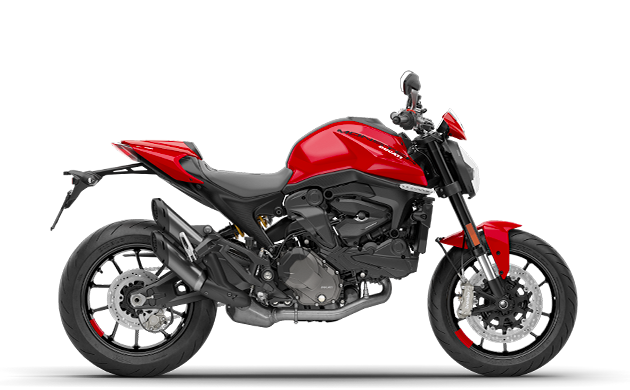
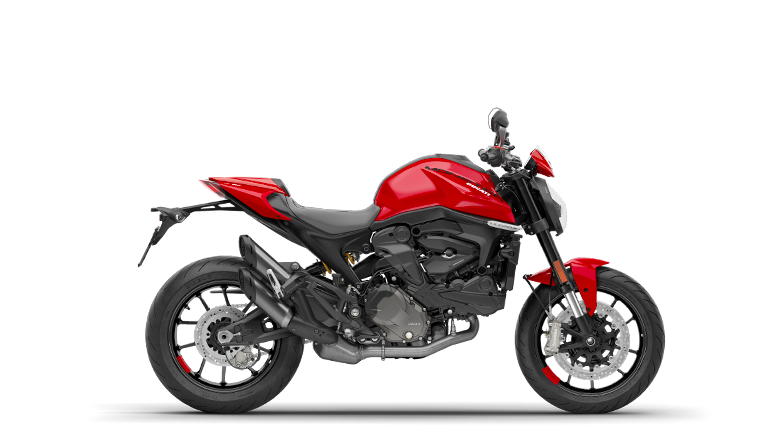
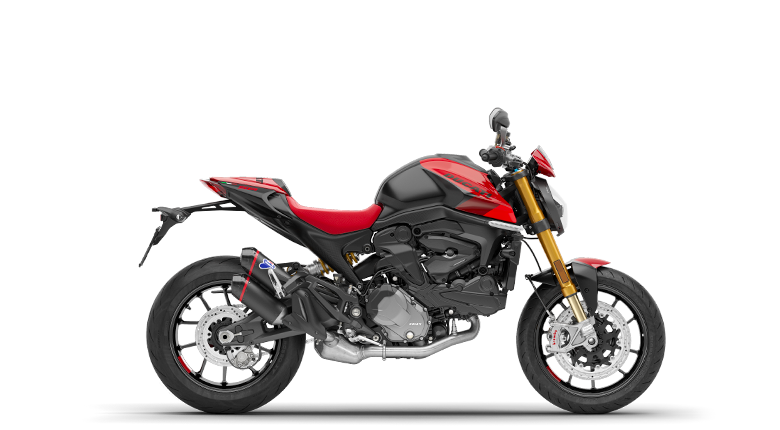
Go to the Monster Official Website!Choose your favorite colour!

DUCATI PRESS | DUCATI CORSE PRESS | WEB MEDIA KITS | OFFICIAL SUPPLIERS