
![]() ![]() ![]() ![]() |
- - ![]() |
|||||
| ||||||
|
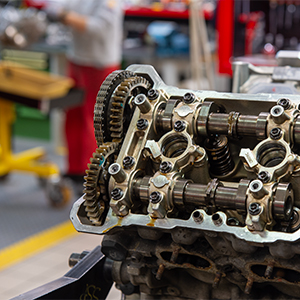
I worked for two other companies before I joined Ducati. I designed a 75 twin camshaft, which was then adjusted for the Giro d’Italia (a twin camshaft was a bit too heavy). So it was turned into a single camshaft and was used in the Giro d’Italia on several occasions, in the Milan – Taranto and lots of other races, under the Ceccato brand. That engine acted as my business card when I was introduced to Count Borselli, on his request. He was looking for a young engineer, with a certain level of experience. I told him that I didn’t have much experience but I showed him the finished engine and said that was what I could do. He said to me: “I’m not interested in the engine but I’m interested in you because I work with 125s and up. I can help you to sell it if that’s what you want to do but I’m not interested in it”. And in fact he did help me sell it to Ceccato. He let me go to Ceccato for the tuning and then I worked at Mondial for two years, until 1954, when I joined Ducati. At Mondial I tuned engines for the Giro d’Italia, 125s and 175s, and then I started work on what was then known as the “Bilancerino”, the 125 with exposed springs and a head similar to the one on the Ceccato. Then I produced the twin camshaft, which was the same as the Ceccato twin camshaft, on a Mondial, and then because of staffing problems I left Mondial and went to Ducati, where I still am today. I actually made my first engine at school, rather than in a workshop, because I was teaching technology at an Industrial School at the time. And since I taught technology, metalwork and design, I used to get the boys to design the parts, do the basic work in the forge and then the finer details in the machine workshop. Then we put the engine together a bit haphazardly but it was the best we could do considering the boys were only 15 years old. So it was hard work getting really accurate parts but because I had risen through the ranks and knew how to use a hammer and a file, I made up for their lack of experience. LUCA TRAVAGLIN I’d like to ask three questions of a theoretical nature. The first one: you talked about the problem regarding point load – load applied to the smaller area. Does this problem also occur when valve opening is concerned? I seem to recollect that to open a Desmo valve, you only rely on a small adjuster, which does nothing to enlarge this area. TAGLIONI The area is actually bigger than we need. The available surface is more than sufficient: it is enough to calculate the effort and curvature of the pad that goes on top according to the Hertz law for it to be strong enough. The adjuster only makes adjustment easier, above all, and secondly, the valve might become dented as it’s not hard enough and clearance might increase. The adjuster’s tip is surface hardened so it won’t be dented. TRAVAGLIN Now another question about ‘tightness’ at low rpm. You said that you can only guarantee valve control with an especially hard spring. Is a spring useless at high rpm? TAGLIONI Completely useless. TRAVAGLIN My last question: for the two-valve “Desmo” engine, the manufacturers recommend a valve check every 3,000 km, while I noticed that this check is only recommended every 20,000 km for the 4-valve engine. What materials change? TAGLIONI No materials change. The thing is that in the 4-valve, the weights involved are much smaller, therefore, the stress on the valve is much lower than in the 2-valve engine. However, it’s not true that a Desmo system should be adjusted every 3,000km. If the Desmo system is well engineered, after a first adjustment at the 1,000 km mark you can use it for another 50,000 without any adjustment – unless the permitted rpm is considerably exceeded. LORENZO BOSCARELLI You launched the racing Desmodromic engine, then for a while Ducati’s racing activities were less successful than in the 1950s. What were you involved in, on a technical level, during that period and what is your most cherished racing memory? TAGLIONI There are lots of stories I could tell. The history of Ducati is very complicated, because we have had many different bosses, so to speak. First there was FIM, who after some hesitation got into racing because of the publicity. We had some victories and provided the factory with some products so we thought it would just carry on like that, but it collapsed. Then we started again with other bosses. After FIM, EFIM came along. EFIM was interested in racing too but we had to start from scratch again. First we had to get the products right and only then market the ones that were going on sale. At the time we were developing the 750 and in order to sell it, I suggested advertising it through racing. We raced at Imola and elsewhere with good results. It was then that I was told we were spending too much money. So I left and when the boss changed again they came and brought me back. We were always going back and forth. When you have one boss you can argue with him. One of you sees things one way and the other sees it differently but in the end you can come to a compromise. But when you’ve got a new boss every day, with new sales strategies, it’s hard to find a solution. From a technical point of view I wanted to develop my own ideas. When they forced me to work on a certain product I quit. I had no problem whatsoever with that, either you do things right or I’m out of there. PERELLI In building a Desmodromic system, which were the biggest difficulties to solve and what’s the Desmodromic system outlook for the future – in the field of motorcycling technology applications? TAGLIONI I would say that there’s been only one initial difficulty: the strength of the seat on the valves. We solved the problem by nitride-coating the valves. The other problems (finding the right set-up and diagrams) are common problems on race bikes. In production bikes, whenever the right technique was applied, we never had any problems with the Desmo system. We’ve built Desmodromic engines for 30 years and we’ve never had problems. As for the future, no one has become interested in Desmo systems so far, because as I said in the beginning, they all thought it was just a way of doing without the springs. Which is absolutely not true: in fact, it’s the other way round. The extra power given by the Desmo system, as I said before, is at least 10% in a petrol engine. You can try any cam, any system, any number of valves, but as long as the valves are controlled by springs, they will perform better in a Desmo. It’s more expensive, it’s more complicated, but if it’s built as it should, the Desmo produces at least 10% more power. Having said that, the main advantage granted by a Desmo system is not the extra power: it’s the extra torque. A Desmodromic engine will start from zero at the highest torque, because a narrower diagram can be used.

DUCATI PRESS | DUCATI CORSE PRESS | WEB MEDIA KITS | OFFICIAL SUPPLIERS |
| Copyright © 2009 Ducati Motor Holding S.p.A. All rights reserved. Terms of use - Privacy Information |